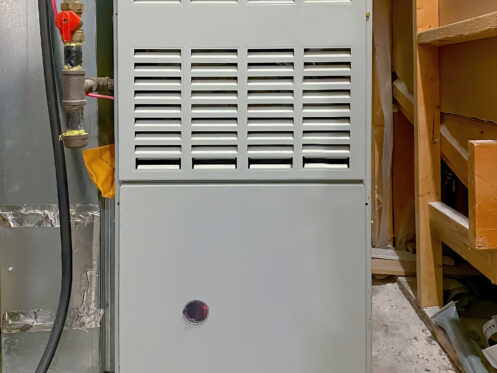
Does your furnace often struggle to keep your house warm enough during periods of extreme cold? Furnaces have to run longer in colder weather to reach and maintain the thermostat’s set temperature. Nonetheless, no matter how cold it is outside, a furnace that’s in good condition and works properly should never run constantly. If your furnace runs constantly, it’s most likely because of one of the following issues.
Clogged Air Filter
Any time you notice that your furnace is running nonstop, the first thing to do is check the condition of the air filter to see how dirty it is. A clogged air filter significantly reduces a furnace’s heating output, as it greatly reduces the amount of air the blower can draw into the furnace. The more clogged the filter is, the less hot air a furnace will put out and the slower it will heat the house.
Under normal circumstances, a clogged filter can lead to a furnace needing to run longer. During a cold spell, it can result in the furnace running constantly and never being able to keep up. A clogged filter also increases wear and tear and can lead to a furnace breaking down. Neglecting to keep up with replacing the filter can take years of life off a furnace.
Check the filter regularly and replace it at least every 90 days. If a cold snap is predicted and the filter has started looking dirty or you can no longer see light through it, replacing it immediately can ensure your house stays warm and reduce how hard your furnace has to work.
Dirty Furnace Burners
One essential part of maintaining a gas furnace is cleaning the burners at the start of each heating season, which is something that should be handled by a trained professional. If the burners aren’t cleaned regularly, the gas ports can become clogged with soot. Soot buildup can lead to incomplete combustion, resulting in the burner flames not giving off as much heat. That means the air the furnace puts out won’t be as hot as it needs to be to counteract the extreme cold.
An even bigger concern with incomplete combustion is that it causes a furnace to produce more carbon monoxide. When a furnace is functioning properly, the main byproducts of the natural gas burning process are carbon dioxide and water vapor. If the gas doesn’t burn cleanly and there’s an issue with the exhaust flue or heat exchanger, it creates the risk of potentially fatal carbon monoxide poisoning.
Dirty or Malfunctioning Blower
The blower works to bring air into the furnace and then distribute the heated air around the house. If it’s coated in dust due to a lack of maintenance or has any other issues, such as worn-out bearings or its motor starting to fail, it often won’t be able to circulate enough air for the furnace to heat effectively.
If the blower starts being excessively loud, it normally indicates that either it’s dirty and needs cleaning or the motor is giving out. Worn-out bearings will usually result in the blower producing a high-pitched squealing sound. This type of squealing sound is a sign that you need to have the blower inspected as soon as possible. If the bearings are worn out and you don’t replace them soon, you’ll end up needing to pay much more to replace the entire blower due to its motor burning out. Should the motor burn out, your furnace will be unable to heat your home until you replace the motor.
Incorrect Thermostat Settings
Another reason your furnace could be struggling during a cold snap is simply that you have your thermostat set too high. This is especially common if the furnace is fairly old or you have an older house that’s poorly insulated or has numerous places where cold air can seep inside. Keeping your thermostat set between 68 and 72 degrees when you are home and awake will allow your furnace to heat more quickly and effectively. Set the thermostat a few degrees lower when your house is unoccupied and at night when everyone is asleep. However, you don’t want to turn it down too far, or your furnace will struggle to achieve your desired temperature once you turn the thermostat back up.
Malfunctioning Limit Switch
The limit switch in a furnace is a crucial component that plays several vital roles. First, it acts as a safety mechanism, triggering an immediate shutdown if the furnace ever overheats. It also constantly communicates with the thermostat and signals the blower to turn on at the start of each heating cycle and shut off once the cycle is finished. The way that the switch works is by measuring the temperature inside the furnace. When the furnace comes on, the switch won’t give the signal for the blower to start running until it senses that the heat exchanger has reached a set temperature. Once the thermostat registers that the house is at the right temperature, it will signal the furnace to shut off. However, the blower will continue to run for a short time until the limit switch registers that the heat exchanger is sufficiently cool.
If the limit switch is faulty or malfunctions, it can fail to sense the correct temperature or fail to give the signal for the blower to shut off. The furnace itself will still shut off in this type of situation, but the blower may run constantly. This leads to the system circulating cool air, resulting in the furnace turning on again fairly quickly.
Uninsulated or Leaky Air Ducts
Uninsulated ductwork in the attic or crawl space or poorly sealed ducts that leak air can cause major issues even during milder weather. If the ductwork in an unconditioned space isn’t properly insulated, the heated air will cool down before it flows out of the vents. This is especially the case during a cold snap when the attic or crawl space is at a much lower temperature, causing the ducts to be extremely cold. Gaps or holes in the ductwork can allow large amounts of hot air to escape. Both of these issues negatively affect how quickly the furnace can heat the house. By insulating your ductwork and resealing or replacing it to overcome air leaks, you can greatly improve your furnace’s performance and prevent unnecessary energy waste.
Furnace Is Undersized
Another issue HVAC technicians encounter more often than you might think is an undersized furnace that’s unable to meet the home’s heating needs effectively. As long as a furnace isn’t massively undersized, it may still work decently well enough on average days. When a cold snap hits and the temperature plummets, even a furnace that’s only slightly too small can struggle to keep the house at the desired temperature.
Unfortunately, the only solution if your furnace is undersized is to replace it. Because many people end up installing an undersized furnace, we encourage you to hire an experienced, local professional whenever the time comes to replace your furnace. An experienced HVAC technician will evaluate the house and perform a heating load calculation to accurately determine the size furnace that will work best, ensuring that you don’t waste your money on a unit that’s either too small or too big.
At Pioneer Valley Environmental, our expert technicians have the skills to help you overcome any furnace issue. We have more than 25 years of experience providing quality furnace services to homeowners in Belchertown and the surrounding areas and are ready to ensure you have reliable heating all winter long. To schedule service, contact us today.