
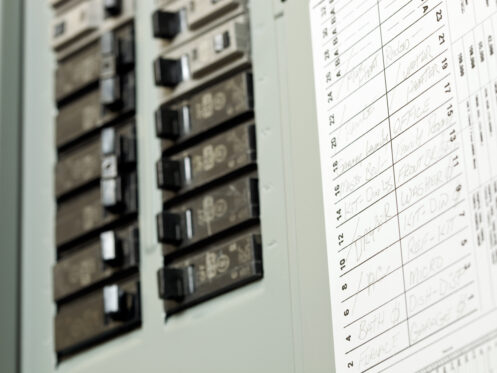
A circuit breaker that keeps tripping is your home’s way of telling you something is off. Sometimes, it’s a simple overload from running too much on one circuit. At other times, it points to a wiring issue, a failing breaker, or a larger electrical problem that should not be ignored.
An Overloaded Circuit Is Still One of the Most Common Causes
A breaker often trips because that circuit is being asked to carry more than it was built for. That can happen ordinarily. You plug a microwave, toaster oven, and coffee maker into the same kitchen circuit, and the breaker shuts off. Or a bedroom circuit is feeding a space heater, a gaming setup, a television, and a couple of chargers simultaneously. Nothing looks dramatic, but the circuit’s still carrying more than it can handle safely. The breaker trips because that is its job. It cuts power before wires get too hot.
This type of tripping often follows a pattern. It happens when one appliance kicks on, when you add a second device, or when you’re using the room more heavily than usual. In older homes, it can show up faster because, years ago, a room wasn’t expected to support multiple screens, work gear, chargers, and portable heating or cooling equipment all at once. If the breaker trips during busy use and then stays on with a reduced load, overload is a strong possibility. It usually means the circuit needs a closer look, especially if that room keeps asking for more power than it can deliver.
Short Circuits and Ground Faults Feel Different for a Reason
Some breaker trips are less about how much power you are using and more about where that power is going. A short circuit occurs when electricity takes a path it’s not supposed to follow, often a much shorter one than intended. A ground fault is similar, though in that case, the electricity is moving toward ground where it shouldn’t. Both can trip a breaker fast, sometimes, as soon as you turn something on. That quick shutdown can feel random if you don’t know what triggered it.
You may notice a pattern like this: The breaker trips whenever you use a bathroom outlet, switch on a lamp, or when rain falls on the outdoor outlet. These details matter. A short or ground fault often traces back to damaged wiring, a failing device, moisture where it shouldn’t be, or a worn cord on something you use all the time.
These situations are more serious than a simple overload because they point to electricity moving in the wrong place, not just too much of it moving in the right place. If the breaker trips right away and does it again without a heavy load on the circuit, the issue may go deeper than you expect.
One Appliance Can Keep Taking the Whole Circuit Down
Sometimes, the breaker reacts to one item rather than the entire circuit. That’s why a trip that happens only when a specific appliance starts up can be so useful. A refrigerator compressor, garbage disposal, treadmill, hair dryer, window unit, or even a lamp with an internal fault can pull the circuit down if something inside the item fails. Motors are especially worth noticing because they draw more power at startup and can behave badly when they begin to fail.
This kind of pattern often shows up as repetition. The breaker trips when the vacuum runs in one room. It trips when the microwave runs for 30 seconds. It trips when the dehumidifier kicks on. That doesn’t always mean the appliance is ruined, though it does mean the connection between that device and the breaker needs attention.
A failing appliance can stress the circuit in a way that looks like a house problem when it is not. The hard part is that many homeowners keep using it because it still works part of the time. If one item keeps taking the power down, that is a clue worth taking seriously rather than treating it as bad luck.
Sometimes, the Real Issue Is Hiding in the Wiring
The most frustrating breaker problems are the ones that don’t follow an obvious pattern. You haven’t plugged in anything new, the circuit doesn’t seem overloaded, and no single appliance stands out. Yet the breaker still trips. In that kind of situation, the wiring itself may be part of the problem. Loose connections inside an outlet box, worn insulation, age-related damage, poor past electrical work, or moisture-affected wiring can all create trip conditions that come and go. That is what makes these problems hard for homeowners to read from the outside. The visible part of the circuit may look perfectly normal.
Houses with older wiring are more likely to experience this, though newer homes are not exempt. A connection can loosen. An outlet can wear out. A switch can start failing inside while still looking fine on the wall. In attic, garage, crawl space, and outdoor circuits, heat and moisture can also add stress in ways that do not show up until the breaker starts reacting. This is one reason not to treat repeated breaker trips as a harmless annoyance. When the panel tells you something is wrong, and the usual explanations don’t fit, hidden wiring conditions move higher on the list of possible causes. That is the point where getting an accurate diagnosis matters more than resetting the breaker one more time.
The Pattern Around the Trip Tells You a Lot
To make sense of a breaker that keeps tripping, pay attention to the pattern around it. Does it happen only in the morning when several kitchen appliances are running at once? Does it happen during storms? Does it happen when one bathroom outlet gets used? Does it happen right away or after 20 minutes? These details help separate an overloaded circuit from a failing breaker, a damaged appliance, or a wiring problem farther back in the line. The more specific the pattern, the easier it becomes to determine the likely cause.
A routine to avoid is where the breaker keeps shutting off,f and everyone in the house starts working around it. That’s when extension cords appear, people move appliances to random outlets, and the same problem keeps recurring. A breaker that trips once may not mean much. A breaker that keeps doing it is telling you the circuit needs attention. Once you identify the cause, the fix may be straightforward. Until then, the pattern of repeated trips is your best clue.
When the Breaker Keeps Winning, Pay Attention
Repeated tripping can indicate overloads, short circuits, ground faults, aging breakers, or wiring problems that may require emergency electrical services. Pioneer Valley Environmental handles electrical repairs, circuit issues, panel work, and safety-focused service that helps you get a clear answer instead of a temporary workaround.
Call us at Pioneer Valley Environmental to schedule electrical service for help with a tripped breaker.